Table of Contents
Published on
Last modified on

5 minutes
Plougrescant Chasm: An Impressive Natural Site
On the Ajoncs Coast, the Gouffre de Plougrescant offersone of the most beautiful landscapes on the Pink Granite Coast. This fissure, where the sea rushes between granite boulders, along with the famous Castel Meur house and the Pointe du Château, creates a setting that’s unique in Brittany. From our campground in the Côtes d’Armor, this protected site is easy to explore on a half-day hike. Here’s everything you need to see to fully enjoy this natural wonder!
Summary of the Article
- A spectacular natural site: The Gouffre de Plougrescant is one of the most iconic landscapes in the Côtes-d’Armor. This fissure, carved into the granite by erosion, offers a breathtaking view of the waves crashing against the rocks.
- The Famous House Between the Rocks: Nearby is the Castel Meur house, nicknamed “the house between the rocks.” Built in 1861 and nestled between two enormous granite boulders, it has become one of the most photographed sites in Brittany.
- A must-see hike: The area is easy to explore on foot via the GR®34 coastal trail, which offers views of the granite outcrops, islets, lagoons, and wild landscapes characteristic of the Côte des Ajoncs.
- A Protected Natural Area: Le Gouffre is a site of great geological and ecological richness. To preserve its natural habitats and biodiversity, visitors are asked to stay on the marked trails and follow the rules for protecting the coastline.
- The Plougrescant Chasm is a marine fault into which the sea rushes, nicknamed “Hell’s Bay.” This designated natural site is open to the public along the Ajoncs Coast. The Castel Meur house, nestled between two rocks, is the most photographed landmark at the site. Access is on foot via an easy loop hike of about 3 km along the Sentier des Douaniers trail. The spectacle reaches its peak at high tide on windy days.
The Plougrescant Chasm, the Bay of Hell Fault
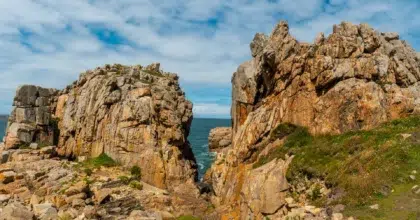
The Gouffre de Plougrescant is a narrow fissure carved into the granite, where the sea surges powerfully at every tide. Nicknamed “Hell’s Bay,” this protected natural site is impressive for the force of the water as it crashes and roars against the walls. The spectacle is at its most spectacular on windy days with heavy swells.
Read more
This fissure was formed over the centuries by the combined action of the waves and the erosion of the granite. All around, the rugged coastline reveals reefs, coves, and rocks sculpted by the elements. This rugged landscape is among the most beautiful in the Côte d’Armor and can be admired from the trail that runs along the shore.
Castel Meur, the house among the rocks
At the edge of the site stands Castel Meur, the famous house wedged between two enormous granite boulders. Built in 1861, it was positioned at this exact spot to protect it from the westerly winds that relentlessly sweep across the headland. This house nestled between the rocks has become the symbol of the Gouffre de Plougrescant and one of the most photographed sites in Brittany.
Read more
The house remains private property and is not open to visitors. Please admire it only from the coastal trail, without entering the grounds or disturbing its residents. Showing respect for the site helps preserve its charm. As the Village Perrosien team often reminds us: “ Castel Meur is best admired from a distance, and that is precisely what makes the place so magical.”
How do I get to the Plougrescant Chasm?
To reach the Gouffre de Plougrescant, park in the site’s parking lot, then follow the approximately 3-km loop along the Sentier des Douaniers. The hike is easy and accessible to everyone, with a few short sections over rocks. Allow about an hour for a leisurely walk around the loop.
Read more
The trail runs along the fault line, passes at the foot of Castel Meur, and then leads to the Pointe du Château, where a jumble of granite boulders plunges into the sea opposite the islets.
Our Tips for Making the Most of Your Visit
A few simple precautions are all it takes to ensure a successful visit to the Gouffre de Plougrescant. The site is open year-round, but the time of day makes all the difference: at high tide and in windy weather, the sea surges into the fissure with impressive force, while at low tide, the site reveals a more peaceful side, perfect for a family stroll.
Here are our tips for getting the most out of it
- Check the tide schedules before you go, because they completely change the experience.
- Try to shoot at the end of the day for soft light and better photos.
- Be sure to wear sturdy shoes; the trail goes over rocks that can sometimes be slippery.
- Be sure to bring a windbreaker—even in the summer—to this very exposed headland.
- Be careful near the shore, especially on days with heavy swells.
What if your next trip to Brittany were all about wide-open spaces and walks by the sea?
Located between the Baie d’Enfer fault and the Castel Meur house, the Gouffre de Plougrescant offers an unforgettable escape into nature. To enjoy this setting every day, stay at our campground near Plougrescant and set out to explore the coast at your own pace!
FAQ – Plougrescant Chasm
What is the Plougrescant Chasm?
The Gouffre de Plougrescant is a natural fissure carved into the granite on the Ajoncs Coast, where the sea rushes in with great force. Nicknamed “Hell’s Bay,” this protected site is one of the most striking landscapes along the Pink Granite Coast. It can be explored freely on foot.
Can we visit the Castel Meur house in Le Gouffre?
No, Castel Meur is not open to visitors, as it is a private residence. You can only admire it from the coastal trail, without stepping onto the property. Respect for the site and its residents is essential to preserving this natural area, which remains very popular.
How do I get to the Plougrescant Chasm?
To reach the Gouffre de Plougrescant, head to the site’s parking lot, then follow the approximately 3-km loop along the Sentier des Douaniers trail. The hike is easy and accessible to everyone, with short sections over rocks. Be sure to wear sturdy shoes and bring a windbreaker on stormy days.
When is the best time to visit the Gouffre de Plougrescant?
The best time to see the Gouffre de Plougrescant is at high tide, on a windy day, when the sea surges powerfully into the fissure. Late in the day also offers soft light, perfect for photos. Be sure to check the tide tables before you visit.