Table of Contents
Published on
Last modified on

5 minutes
Beach fishing in the Côtes-d’Armor: a traditional coastal activity
Beachcombing is one of the most typical activities along the Côtes d’Armor coastline; it’s accessible at low tide and requires no permit. Along the Pink Granite Coast and in Saint-Brieuc Bay, the foreshore is teeming with cockles, clams, periwinkles, and velvet crabs. But you still need to know the best spots, respect the minimum sizes, and keep an eye on the tides. From our campground in the Côtes d’Armor, you can reach these playgrounds in just a few minutes: here’s what you need to know to set out with peace of mind, basket and rake in hand.
Summary of the Article
- An iconic activity along the Breton coast: Shore fishing is a much-loved tradition in the Côtes-d’Armor, especially during spring tides. It allows people to gather shellfish, crustaceans, and other marine species on the foreshore that is exposed at low tide.
- Places renowned for their abundance: Many of the department’s beaches and rocky areas offer excellent spots for shore fishing, where you can find clams, cockles, mussels, periwinkles, horsehair crabs, and even edible crabs, depending on the area and the season.
- A practice governed by regulations: Shore fishing is subject to specific rules regarding minimum catch sizes, permitted quantities, and fishing areas. It is also recommended to check the sanitary conditions of the sites before harvesting.
- A nature outing that requires careful planning: To enjoy this activity safely, it is essential to check the tide schedules and tide heights, monitor the weather, and respect the natural environment in order to preserve the biodiversity of the coastline.
Key Takeaways
| Appearance | Key Takeaways |
|---|---|
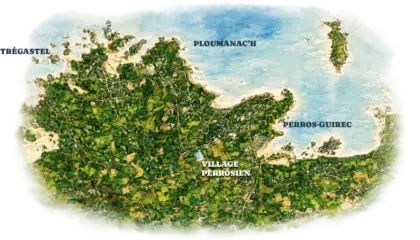
| Where to Fish | The Pink Granite Coast (Ploumanac’h, Trégastel, Perros-Guirec) and Saint-Brieuc Bay. |
| Common Species | Clams, mussels, razor clams, periwinkles, crabs, and edible crabs. |
| Minimum sizes | Clam: 4 cm, cockle: 2.7 cm, razor clam: 6.5 cm, crab: 15 cm. |
| When to Go | During an outgoing tide, 2 hours before low tide, during spring tides. |
| Rules to Follow | Daytime fishing by hand, for personal consumption only. |
Where can you go beach fishing in the Côtes-d’Armor?
The Côtes-d’Armor boasts nearly 350 km of coastline, offering a wealth of opportunities for shore fishermen. Two distinct areas stand out: the Pink Granite Coast to the north and the vast Bay of Saint-Brieuc. All along the Côtes-d’Armor coast, the foreshore alternates between rocky outcrops and wide stretches of sand, allowing for a variety of catches depending on your preferences.
To help you find your way around, here are a few well-known spots in the area
- In Ploumanac’h, the rocky coves are home to shore crabs, crabs, and periwinkles among the granite boulders.
- La Grève Blanche, in Trégastel, features a large sandbar that is ideal for cockles and razor clams.
- Pors ar Villiec Beach in Perros-Guirec combines fine sand and rocks, making it ideal for families.
- In the Bay of Saint-Brieuc,Yffiniac Cove boasts vast sandy shores renowned for their clams.
Which shellfish should you collect, and what size should they be?
Several species can be easily caught, provided that the minimum catch size is observed. This rule protects the resource and ensures good fishing season after season.
Here are the main sizes you need to know in the department
- Clams can be harvested starting at 4 cm, and cockles starting at 2.7 cm.
- The horsehair crab reaches the legal minimum size of 6.5 cm, and the edible crab reaches 15 cm.
- Crab can be caught starting at 12 cm, and abalone at 9 cm.
- There is no minimum size requirement for periwinkles and green crabs.
In practice, a simple ruler slipped into the bucket can help prevent many mistakes when sorting through the sand. It’s better to put a shell that’s too small back in the water than to walk away with a harvest that doesn’t meet the standards!
Our favorite spot: At low tide, head out to the edge of Renote Island in Trégastel. This little spot, less crowded than the larger beaches, reveals pretty rocky pools where shrimp and shore crabs hide. Regulars come here as soon as the tide starts to go out, bucket in hand, to enjoy the peace and quiet before the sea returns.
Regulations and Best Practices
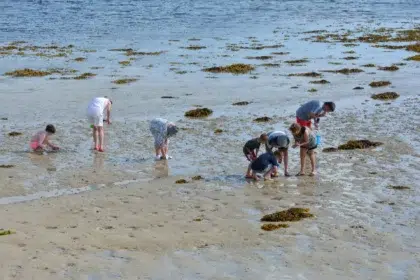
Beachcombing in the Côtes-d’Armor remains unrestricted and free, but it is subject to specific guidelines set by the prefecture. It may be practiced only during daylight hours, between sunrise and sunset, by hand or with simple tools such as a knife, a rake, or a landing net.
Read more
The catch is sorted as it is brought in, directly at the fishing site. Furthermore, gathering is prohibited within 15 meters of shellfish farming concessions, and the harvest is intended exclusively for family consumption— never for sale.
A Successful Trip Out to Sea: Tides, Tidal Range, and Safety
The success of a fishing trip depends first and foremost on the tide. To take advantage of a wide foreshore, aim for the outgoing tide and arrive at the site about 2 hours before low tide. In fact, spring tides—with a tidal coefficient greater than 100—expose the most ground and reveal the areas with the highest concentration of fish. Safety remains a top priority, however, as the tide comes back in quickly—sometimes faster than you might expect.
Read more
So keep an eye on high tide times and always keep a landmark on the coast in sight. As the team at Village Perrosien reminds us: “On the Pink Granite Coast, the best harvests happen during the spring tides, when the sea recedes very far.”
Want to turn every low tide into a family adventure?
For your next beachcombing trip in the Côtes-d’Armor, our campground, Village Perrosien, is located near the most beautiful spots on the Pink Granite Coast.
FAQ – Shore Fishing in the Côtes-d’Armor
Do you need a license to fish from the shore in the Côtes-d’Armor?
No, no permit is required to fish from the shore in the Côtes-d’Armor. This activity is free and open to the public, provided you comply with minimum size limits, catch reasonable quantities, and fish only in authorized areas. Your catch must be used solely for your family’s consumption and may not be resold.
When is the best time for beach fishing?
The best time to visit is during spring tides, when the tidal range exceeds 100 and the sea recedes very far. The foreshore is then largely exposed, opening up many more accessible areas. The equinoctial tides, in spring and fall, are among the most generous along the Côtes-d’Armor coastline.
Where can you find clams on the Pink Granite Coast?
Clams thrive in areas where sand mixes with mud, such as the large sandy beaches of Trégastel or the sheltered coves around Perros-Guirec. Look for small, figure-eight-shaped holes on the surface of the sand, then gently scrape at them with your fingernail. Always check that they meet the minimum size requirement of 4 cm.